
SALT partners Zachary Atkins and Aruna Chittiappa will be presenting at this year’s event.



SALT partners Zachary Atkins and Aruna Chittiappa will be presenting at this year’s event.
SALT partner Evan Hamme will be presenting at TEI’s Annual Conference on October 20.

Pillsbury attorneys Carley Roberts and Annie Rothschild will be speaking at this year’s All-Tax Conference.

SALT partners Carley Roberts, Zachary Atkins and Evan Hamme will be speaking at COST’s Annual Meeting on September 24 in San Antonio, Texas.

 Pillsbury’s State and Local Tax team has received recognition in the latest edition of Best Lawyers, with several attorneys honored across tax litigation, controversy and tax law categories in California. Recognized attorneys include:
This recognition reflects the continued strength of Pillsbury’s SALT practice and its depth of experience advising clients on complex state and local tax matters, including tax controversy, litigation, audits, administrative proceedings and strategic tax planning.
Best Lawyers is a peer review publication that recognizes attorneys for professional excellence in their respective practice areas. The inclusion of multiple SALT team members across California underscores the group’s broad capabilities and reputation in both controversy and transactional tax matters.
Congratulations to Craig, Breann, Carley and Jeffrey on this well-deserved recognition.

SALT attorneys Zachary Atkins, Aruna Chittiappa, Evan Hamme, Jeff Phang, Nolan Kessler and Breanna Zagorski will present live at COST’s SALT Webinar on August 11.

SALT attorney Annie Rothschild will be presenting at the Multistate Tax Policy 101 webinar on September 15.

Pillsbury SALT partner Breann Robowski will be presenting at the 2026 Wichita Property Tax Conference.
SALT partner Aruna Chittiappa will be presenting at the 2026 Introduction to State and Local Taxation Conference on July 28.
We are pleased to announce that Pillsbury’s State & Local Tax (SALT) practice has been recognized in the 2026 edition of The Legal 500 United States in two categories: US Taxes: Contentious and US Taxes: Non-Contentious.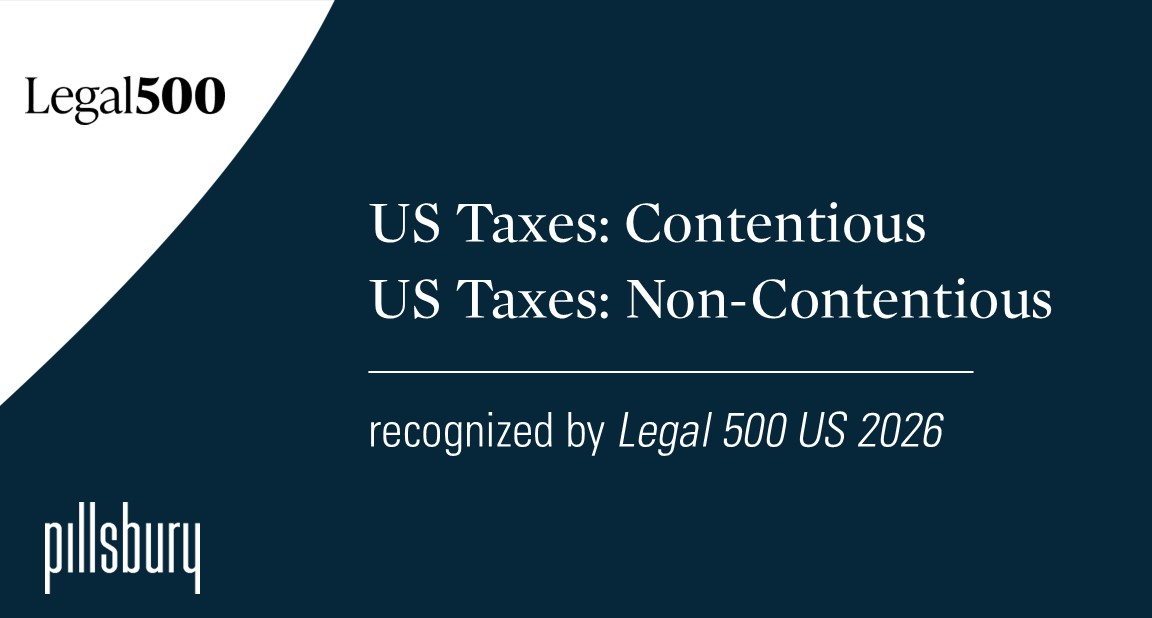
These rankings reflect the breadth of our SALT platform — from high-stakes controversy and litigation to transactional tax planning and advisory work — and the strength of the team delivering results across both areas.
The Legal 500‘s editorial highlights the depth and range of the practice. As the guide notes, Pillsbury’s SALT team “is a premier US multistate tax practice, with bright minds and decades of experience representing companies on complex issues. Few practices combine that depth of expertise with such seamless collaboration.”
The guide further observes that “Pillsbury’s state and local tax team is one of the leading multistate tax groups in the US. It has the breadth and depth to handle virtually any state tax matter, from advisory to high-stakes controversy.”
We are grateful for the feedback our clients shared with The Legal 500. Here is a selection:
“The team is comprised of true all-stars, with a strong mix of seasoned leaders and dynamic younger partners. Team members stand out as exceptional lawyers who combine technical strength with approachability.”
“Team members include some of the top indirect and state income tax attorneys in the country, trusted by some of the largest companies in the world, and among the strongest property tax lawyers in the US, delivering significant results on high-profile matters.”
Congratulations to the entire SALT team on this well-deserved recognition. These results underscore the talent, dedication, and collaborative spirit that define our practice.
For more information on Pillsbury’s SALT capabilities, visit our practice page or view our full Legal 500 profiles for US Taxes: Contentious and US Taxes: Non-Contentious.