 SeeSALT Blog


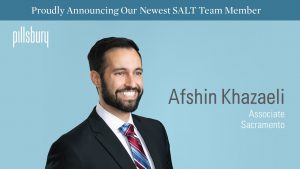
CPA and former Big 4 associate, Afshin Khazaeli joins Pillsbury SALT!
Afshin advises clients on a variety of state and local tax matters, including controversy, planning, and audit defense, across all state and local tax types, including sales and use, income, franchise, and property tax. Pillsbury SALT is thrilled to welcome him to our award-winning team. Afshin is based in Pillsbury’s Sacramento office.
5 Questions with Afshin
- Who inspires you?
I’m inspired by my father and his relentlessness. - What drew you to the law?
I love being a trusted advocate for my clients. - What aspect of State and Local Tax law do you find most interesting?
State and local tax is constantly changing, evolving and adapting. - What has been your most challenging or rewarding case?
Each case has been uniquely challenging, and the most rewarding cases are when I help my clients achieve unexpectedly great results. - What is your go-to comfort food?
Persian food! Reminds me of my mother’s cooking and being back at home.
Welcome to Pillsbury SALT, Afshin!
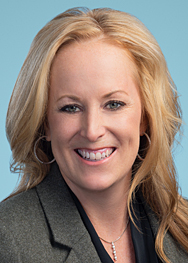
 Pillsbury SALT was proud to present TEI/IPT Silicon Valley’s State and Local Tax Day & IPT Joint Meeting on December 5! The team presented a 3/4-day seminar that focused on topics related to the State and Local Tax implications of the Tax Cuts and Jobs Act, the U.S. Supreme Court’s decision in Wayfair, and other hot topics in state and local taxation.
 Pillsbury has earned a total of 154 national and regional practice rankings in the latest U.S. News – Best Lawyers 2020 Best Law Firms survey.
 There were two competing bills regarding tax sharing agreements (TSAs) this legislative session: SB 531 and SB 485. The former would have barred all TSAs at the local level as of January 1, 2020. The latter would not bar TSAs but instead would require the locality to report certain information pertaining to the agreement that would be made publicly available. On October 12, 2019, Gov. Gavin Newsom vetoed the bill that would have barred TSAs altogether and instead signed the other bill that requires publicly reporting certain information pertaining to the TSAs.
 Yesterday, the California Franchise Tax Board convened a public meeting to discuss tax compliance within the growing gig economy and the challenges of meeting these obligations. Speakers from academia, the FTB, the business community, and gig workers themselves, discussed various tax issues, three of which stood out.